The Circle of Control
Everybody feels stressed or anxious at some point in their lives, whether that be in their personal lives or in their professional lives. There are often very valid reasons to feel this way, but often, if you look closely at the cause, it is down to something that is beyond our control. Heavy traffic making us late for a meeting, the fridge breaking down in the middle of summer or some other unexpected expense or inconvenience. At these times it is good to consider the Circle of Control.
The concept of the Circle of Control was popularised by Stephen Covey in his book 7 Habits of Highly Effective People and is also a core concept in stoicism. It is a fantastic and effective framework to enable us all to navigate a busy, chaotic and unpredictable world.
At its core, the Circle of Control asks a simple question, where are you, and where should you be directing your energy and focus.
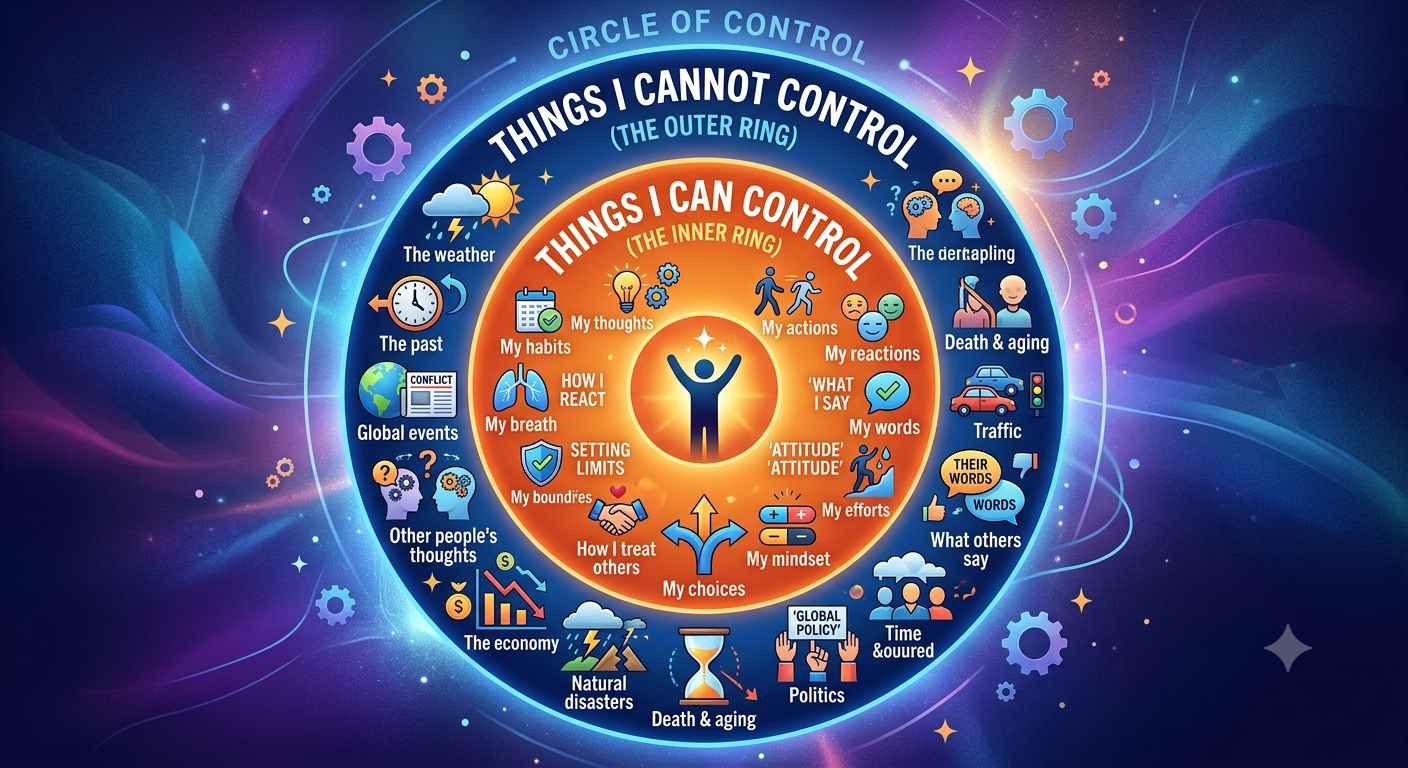
The basic core concept of the Circle of Control.
The model for the Circle of Control can be done in two ways – many more if you want to bring in various other theory’s, but the two I mention are the most effective. The first and simplest representation is the two circle approach. The inner circle is what you have control of, and the outer circle is everything you don’t have control of. However, I find this to be too simplistic and prefer the three ring variant. It has more nuance without over complicating the situation. Let’s take a closer look.
Understanding the Three Circles.
The three circle model offers a much clearer vision of where you should be directing your focus and energy without overcomplicating or overwhelming you in moments of stress. After all, the idea behind the Circle of Control is to help reduce or avoid unnecessary stress and anxiety as well as helping you decide what requires your attention. Imagine three circles stacked on top of each other or rings, getting smaller as you work your way inwards. The outer circle is the Circle of Concern, the middle one, the Circle of Influence and finally, the smallest at the centre, the Circle of Control.
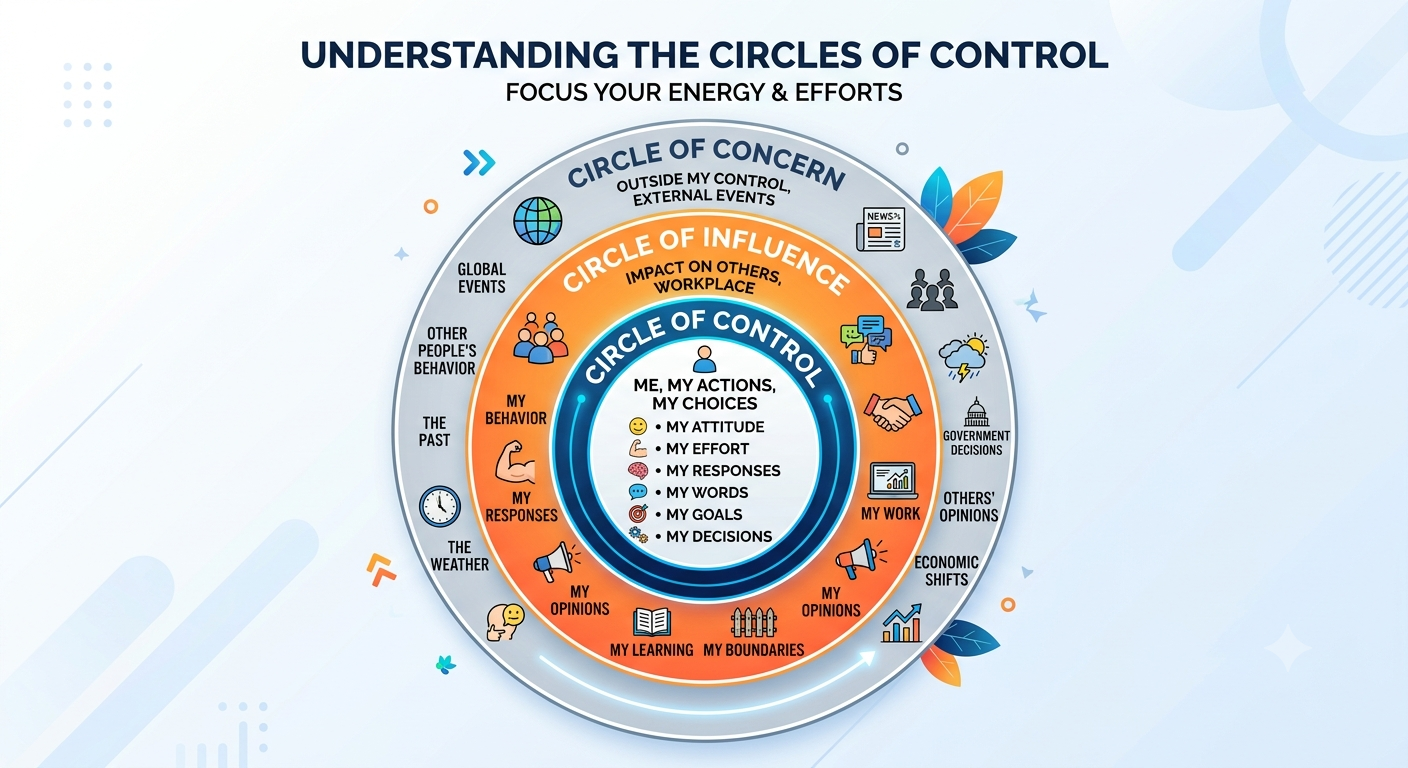
The three ring version of the Circle of Control.
The Circle of Concern. This is the largest circle and forms a wide ring around all the others. It contains all the high level, grand events and influences which concern you. Some of these things have no direct impact upon your life, others do. The key to this circle is that you have no direct leverage. You are unable to affect change or influence in any meaningful way by yourself. Things that might appear in this circle are global events, such as wars or politics, the economy. Closer to home, other people’s opinions and actions also fall into this circle. These things may cause you concern or interest you, but as you have no control or direct leverage over these, you should work to focus your energy where you can have an impact. Equally, although some of the events within this circle may cause you distress, you should try not to allow them to cause you stress or worry as they are beyond your control.
What’s inside: Global wars, the national economy, interest rates, traffic jams, the weather, other people’s thoughts, and other people’s actions.
The reality: Spending mental energy or focus here has no tangible return. Individual actions do not or cannot effect the Circle of Concern, and focusing on this area can only bring stress and exhaustion.
The Circle of Influence. The middle ring is where you can begin to focus some of your energy. It contains things that you cannot dictate, but you can shape. You still have no direct leverage over the contents of this circle, but through persuasion and your actions you can begin to shape and influence. This is often called the lead by example or treat others as you wish to be treated circle. In this circle are actions and attitudes such as how you treat others, recommendations, your team’s performance and culture. You do not have direct leverage to enforce and control others, but through your words and actions you can steer and influence the final outcome. This is an area where you should put some of your energy, but still not too much of your stress. By putting in some effort you can reap the rewards, not just for you but fr everyone involved. If you push too hard though, you are likely to cause push back and therefore more stress. It is best to put a little energy here, but not allow yourself to stress or worry about the final outcome.
What’s inside: Your team’s performance, your team’s culture, your child’s behaviour, friend’s decisions and attitudes.
The reality: You can prepare a compelling presentation, but you can’t make the client sign. You can recommend a movie or book to a friend, but you can’t make them enjoy it. You can act, talk and shape others, but you can’t control the outcome.
The Circle of Control. The inner circle and also the smallest. Here is where you have direct leverage and where you have full agency. This is where the majority of your energy should be focussed. It is also the area that if causing you stress, you should focus on that too, as you can directly affect change to reduce or eliminate the stress. Things in this circle are under your direct control, your actions, your effort and your mindset. In this circle is crucially, how you react and respond to your environment, situations and other people. Your world and how you react to it are directly controlled by you, there is no need to persuade or influence here. You can make a decision and have full control, full agency to follow through with it.
What’s inside: Your thoughts, actions, habits, words, boundaries and how you react to others and the outside world.
The reality: You cannot control if someone shouts at you, but you can control if you shout back. You can control how you think, act and respond, but you cannot control the outcome and the world around you. If something in this circle is causing you stress, you have agency and direct leverage to change it.
Reactive Vs Proactive Focus.
When choosing where to direct our focus and energy, we can choose to be proactive or reactive. At times, situations and events fall outside our control or influence, other times they fall within our Circle of Control. Choosing to be proactive rather than reactive as much as possible helps lower stress and anxiety. Also by being proactive, you can expand your influence and control over time.
|
Reactive Focus |
Proactive Focus |
|
Focuses on the circle of concern |
Focuses on the circle of control |
|
Blames circumstances, other people or bad luck |
Asks What can I do about this right now? |
|
Creates internal feelings of helplessness, anxiety and frustration |
Creates feelings of agency, calmness and self-efficacy |
|
Result: Your influence and happiness shrinks over time |
Result: Your influence and happiness expands and grows over time |
The key takeaway is not to ignore external problems, but to simply proactively focus your attention and energy on those that you can actually impact. This means focussing on the core Circle of Control and, to a lesser extent, the Circle of Influence, whilst realising that you cannot directly impact the Circle of Concern.
Three Practical Tips to Shift your Focus.
Conduct an Energy/Focus Audit. When you feel stressed or overwhelmed, write down everything causing you anxiety. List each item under the circle it relates to, the Circle of Concern, Influence or Control. From there, you can decide if it requires any focus, and if so how much.
Drop or Reframe the Outer Circle. For items in the Circle of Concern, actively decide to let go of the emotional attachment, this will allow you to look at the problem purely logically, and if you realise you cannot directly influence the situation, drop it. For some aspects, you may be able to influence a smaller part of the bigger problem. For example, you can’t control the weather, but you can dress, or pack appropriately, such as taking an umbrella if it is going to rain.
Ask the Default Question. When you hit a roadblock, ask yourself which circle the problem sits in and if it sits within the Circle of Influence or Control, what is the single best action I can make, that is within my control, to remove or reduce the issue at hand.
Conclusion.
Not everything is in our control. We can only control ourselves, our actions, words and reactions. Everything else is beyond our direct control, some things may be able to be influenced by ourselves, but if they can’t we must accept this. By understanding the Circle of Control and its two outer rings, we can proactively choose where and how to direct our focus and energy. In order to reduce the stress and anxiety we face in our daily lives, we need to know what we can directly leverage, what we can influence and what we have no effect upon. By learning to let go of that which we cannot control, we focus on that which we can, building meaning in our lives and influence around us.